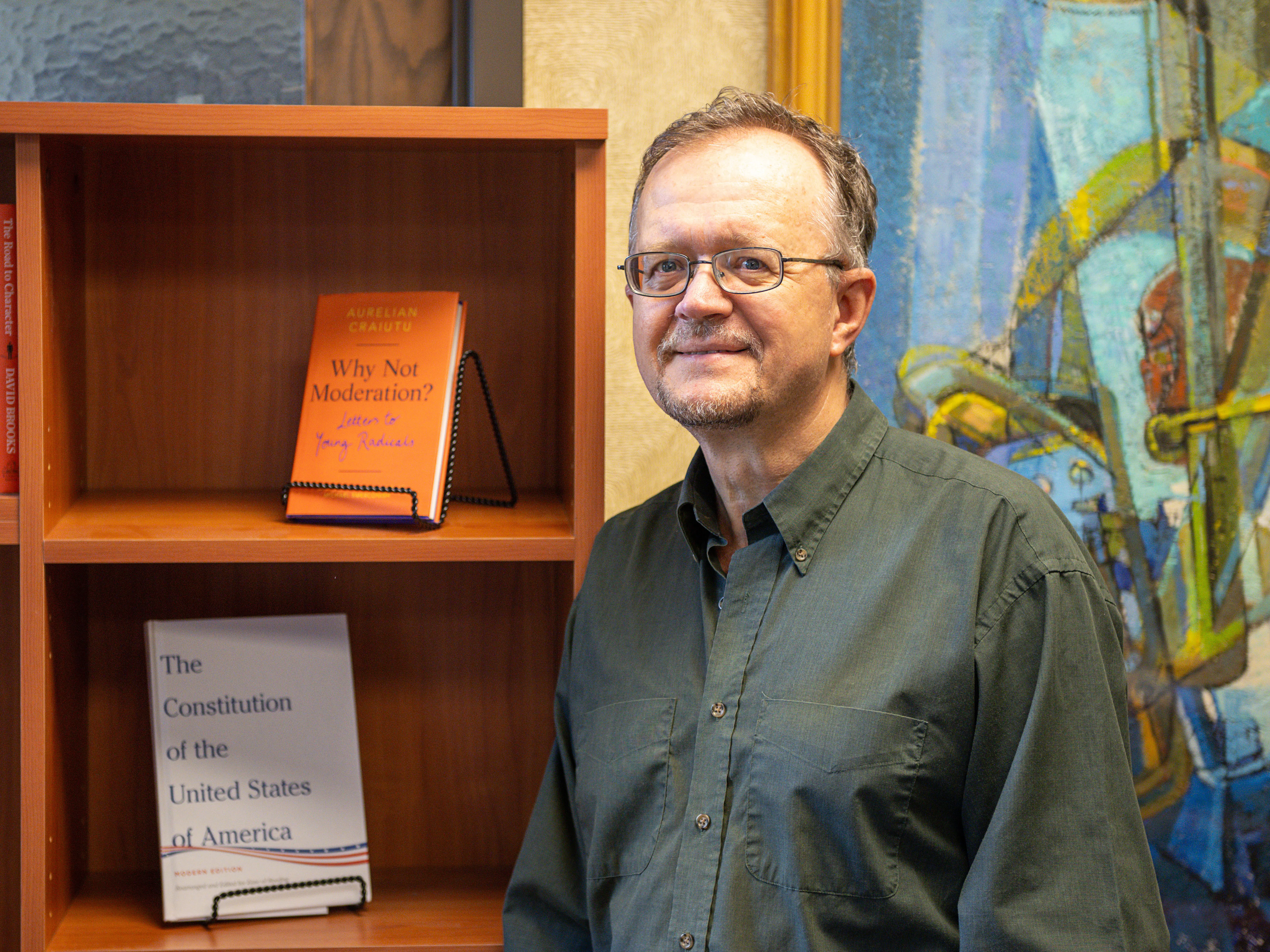
Aurelian Craiutu grew up in communist Romania and now chairs political science at Indiana University. For twenty years his subject has been what virtues that keep a free society's institutions alive, and how they are taught.
On Tuesday mornings in the mid-1980s, an economics student named Aurelian Craiutu went to an apartment in Bucharest to read books that could not be found anywhere else in Ceaușescu's Romania. There was a German history of philosophy in the old Gothic script, Aristotle's Metaphysics, Augustine's Confessions, Pascal, and Simone Weil. Some of them were banned. The apartment “was like an island of freedom in a world that was not free.”
He was not supposed to be there. At 18 he had won Romania's National Olympiad for Literature but chose economics because a literature degree meant teaching in a village with no train, and economics under communism meant four years of Marxist political economy. “Another self-inflicting wound,” he says. The education that counted happened in the Bucharest apartment.
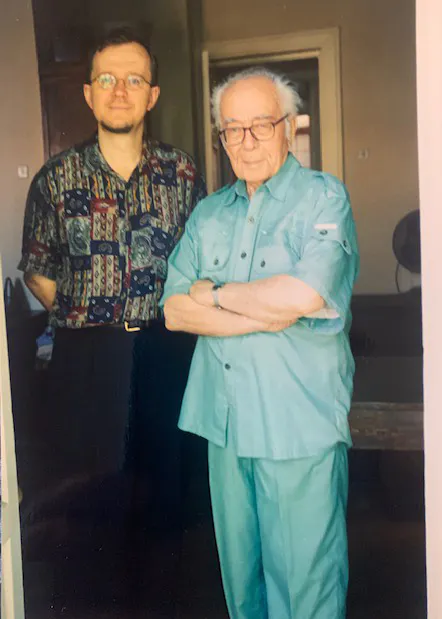
It belonged to Mihai Șora, a retired philosopher of 68 who had studied with the writers of Romania's golden generation in the 1930s, published in Paris, and returned home in 1948 to visit his family, never to be allowed out again. What he had was a library in seven languages, and he took over the rest of Craiutu's education. For four years they read, walked the city, and twice spent weeks at a sixteenth-century monastery in the north, talking philosophy under the frescoes. “I still feel in some ways that through him,” Craiutu says, “I connected to the good part of the history, and kind of put the 40 years of communism in a parenthesis.”
Forty years later, his own students at Indiana University are free to read anything. Their world is far freer than the one he grew up in, and he says so. But they are overbooked, in debt, and on their phones, with no time to sit in a coffee shop and talk about a book. What they lack, he thinks, is a compelling reason to open the books. They were written, he says, to answer one question: “how we ought to live.”
So he opens his introductory course in political theory with a letter Machiavelli wrote in 1513. Machiavelli takes off his muddy clothes, dresses as if for court, and sits down with his books, where the ancients receive him and answer his questions. For four hours he forgets his troubles and does not fear death. “I invite you to partake into a conversation with the great minds of mankind,” Craiutu tells his students. Then he turns to Seneca, the Roman Stoic, who wrote that while we cannot choose our parents, there are households of the noblest minds, and we can choose which one to be adopted into. Liberal education, he reminds them, takes its name from the Latin word for free. Its old opposite is servile, a mind put to work with no say in its own formation.
In the Romania he grew up in, the answer to how we ought to live was handed down, and the books that questioned it were locked away. In a free society, no one chooses for you and no one holds the whole answer. Each side has, as he puts it, “fractions of truth.” So the question has to be argued, and the arguing has to be taught. “You have to learn the art of disagreement—the art of civil disagreement—not shouting,” he says. His 2023 book, Why Not Moderation? Letters to Young Radicals, tries to teach it to two invented students, one on the left and one on the right. On October 1, the Wall Street Journal's Barton Swaim devoted a column to it: “A Suggestion for Young Radicals.”
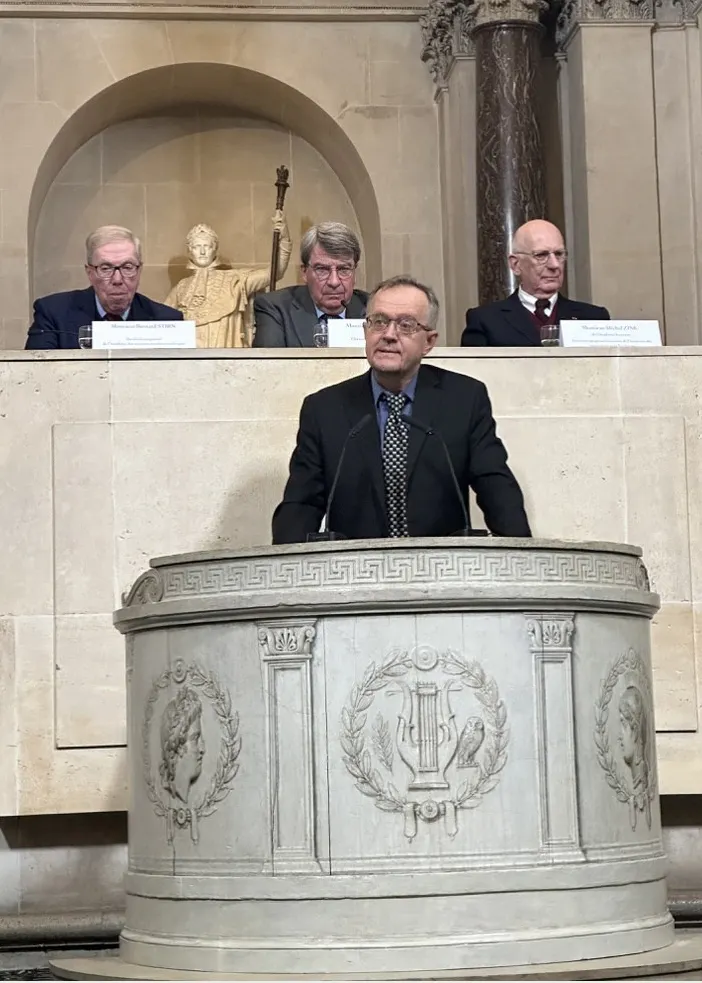
Craiutu came to those questions himself after the revolution of 1989. In Rennes, France, he first read Tocqueville. Democracy in America, he says, “still remains the most relevant book.”
At Princeton, as the only East European among the political theorists, he read Tocqueville and Popper as if lives depended on them. “I wasn't just thinking, well, what did Tocqueville say in abstract?” he says. “How can we apply those ideas to a post-communist scenario? How to build representative government, how to deal with opposition, how to contest power.”
To his classmates, who had grown up under a working constitution, those questions seemed, as he puts it, “settled or uninteresting.”
There were rooms where they were not. In June 1995 he drove from Princeton to an IHS summer seminar at Bryn Mawr, where he encountered a week of lectures on liberty with time afterward to argue about them.
Thirty-one years on, he can still name the people from that week. Jeremy Shearmur, Karl Popper's former assistant, lectured on Popper. Leonard Liggio, who had run IHS through the 1980s, sat with the students at dinner. Craiutu admits that he was also there for the books. “Free books has always been very important for me,” he says.
Then the questions came back to life, but in his adopted country this time. “I've been interested in these attacks on liberalism that have become very prominent since 2016 or so,” he says. “That's where I picked up the collaboration again with IHS.” He was an IHS Senior Fellow in 2020–21, and last year he held a workshop IHS supported on his next book. Among the scholars giving feedback was Matthew Kuchem, his former doctoral student, who now directs IHS's Liberal Democracy and Civics initiative, where he asks the question his teacher has spent twenty years on: what a free society asks of the people who live in it.
Having grown up without freedom, Craiutu counts himself “perhaps more appreciative of the virtues of America” than he would otherwise be. “This is an experiment here. It can go wrong. It has gone wrong at times.” But the greatest advantage of democracy, he adds, quoting Tocqueville, “is that it gives us the ability to make repairable mistakes.”