
What if politics isn’t “left versus right” at all, but an amorphous and unprincipled “us versus them”?
That idea first came to Verlan Lewis, now the Stirling Professor of Constitutional Studies at Utah Valley University, then an undergraduate at BYU during a visit from his older brother (and future coauthor) Hyrum. It was the mid-2000s. Verlan had just lamented that President George W. Bush “wasn’t being conservative”; there was more spending, bigger deficits, and expanding regulation. Hyrum pushed back: maybe the word “conservative,” as it is commonly used, doesn’t mean the same thing all the time. Maybe the one-dimensional left–right spectrum isn’t a map of principle at all, but a story tribes tell to make shifting positions feel coherent.
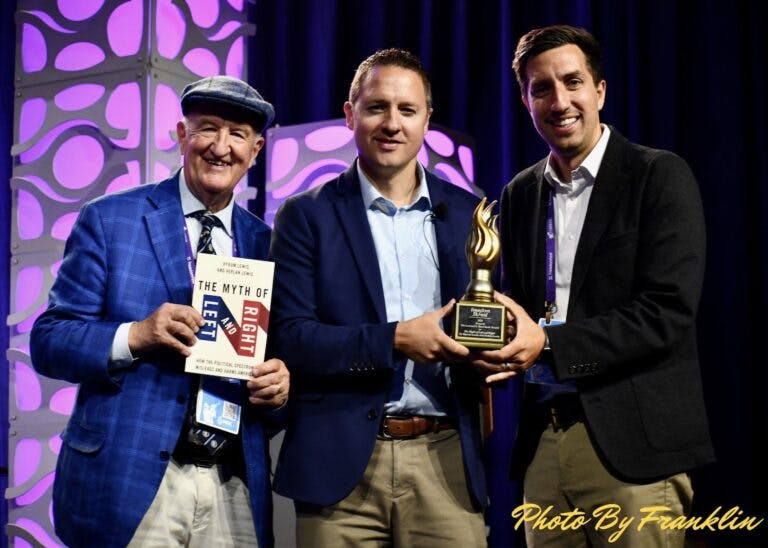
That question stayed with Verlan. Over months and years, debate turned into research, and research into a book: The Myth of Left and Right. Their argument is disarmingly human: people don’t derive their stances from a grand philosophy; they join a team (often for one salient reason or through social ties) and then adopt the rest by social osmosis. The spectrum, useful for a single issue (say, support for the New Deal in the 1930s), became a harmful shorthand once politics sprawled into dozens of dimensions. The result is polarization masquerading as principle.
From his earliest encounters with American history, Verlan had been drawn to figures who treated power as a trust, not a prize. George Washington’s decision to surrender command of the army, and later to step down after two terms as president, left a deep impression on him. The restraint that made self-government possible became, for Verlan, the moral heart of the American experiment.
His moral outlook is also anchored in experience. As a member of the Church of Jesus Christ of Latter-day Saints, Verlan comes from a long line of religious minorities seeking freedom. That heritage made him a defender of constitutional limits, structures that disperse authority because power tends to accumulate and abuse. Few understand the danger of unchecked power better than those who have lived under it.
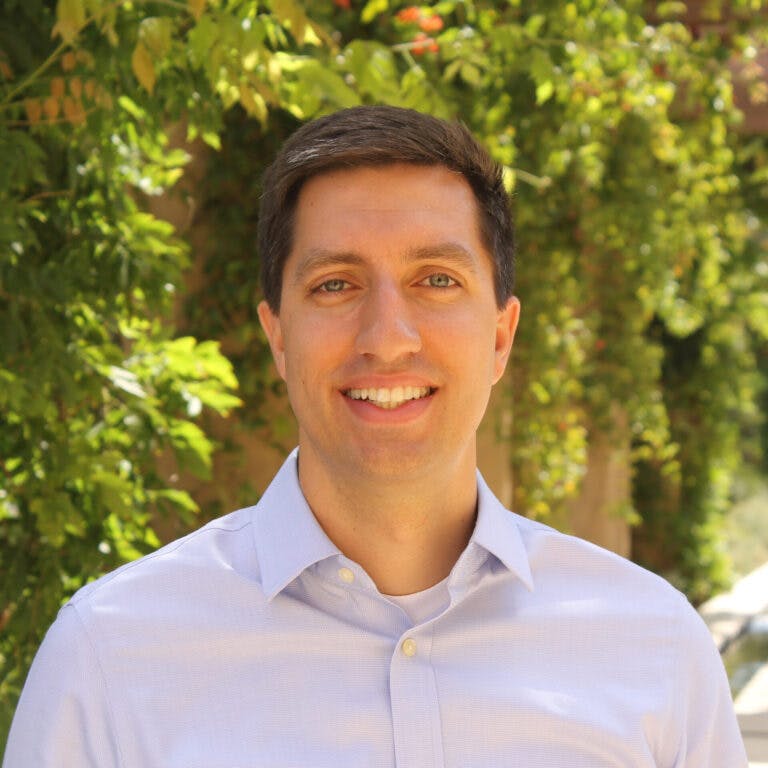
Verlan first encountered the Institute for Humane Studies as a high schooler in Oregon while searching for scholarships. A pamphlet pointed him to IHS.
In college and early in his career, he crossed paths with the institute again and even worked briefly on its early faculty network project before graduate school. Later, IHS supported him with funding, community, and platforms for public programming. For Verlan, what resonated most was the principled, nonpartisan, and pluralist culture.
In 2022, with support from IHS, Verlan brought Arthur C. Brooks to Utah Valley University to speak on Love Your Enemies: How Decent People Can Save America from Our Culture of Contempt. The event drew nearly 500 participants. Its message, that empathy and pluralism are civic virtues, has only grown more urgent in today’s polarized climate.
Today, Verlan teaches and writes to lower the temperature and widen the lens.
He urges students to treat politics as plural, with many issues, many trade-offs, and many opportunities for humility. Don’t outsource your thinking to team narratives. Don’t pretend one label can carry 85 issue positions without contradiction. Start with freedom and then test every claim, including your own.
That’s the work IHS makes possible: helping scholars like Verlan Lewis replace slogans with humility and understanding, so that self-government becomes something we actually practice.
By supporting IHS, you invest in scholars like Verlan at a formative stage in their careers—not only with crucial financial support, but also with inspiration and connections to other like-minded and driven intellectual collaborators that they can’t find anywhere else.