The Institute for Humane Studies has launched Classical Liberal Mind, a free AI platform at ClassicalLiberalMind.ai that lets students, educators, and curious readers carry on conversations with 29 of the thinkers whose work built the modern liberal tradition. The roster spans three centuries and several disciplines: Smith, Hume, Locke, and Madison sit alongside Hayek, Friedman, and Mises; Wollstonecraft, Arendt, and Ostrom alongside Douglass, Tocqueville, and Mill; and Bentham, Berlin, Popper, Rawls, and Nozick alongside Bastiat, Buchanan, Ricardo, and Tullock.
"We've always believed the right ideas, reaching the right people, change the world," said Jim Ronyak, managing director of information technology at IHS. "Today, that means building technology that closes the distance between a student and the scholars whose work can transform how they think."
The platform rests on a conviction that cuts against the common worry about AI in education: that AI should deepen engagement with ideas rather than substitute for it. Many educators fear students will use AI to avoid hard texts. Classical Liberal Mind works the other way, treating reading as a conversation that draws students into the text instead of around it.
"Students can push back on arguments, test assumptions, and explore disagreements through conversations with the thinkers themselves," said Sam Johnson, director of scholar networks and partnerships at IHS. "That makes learning more active, more demanding, and more intellectually serious."
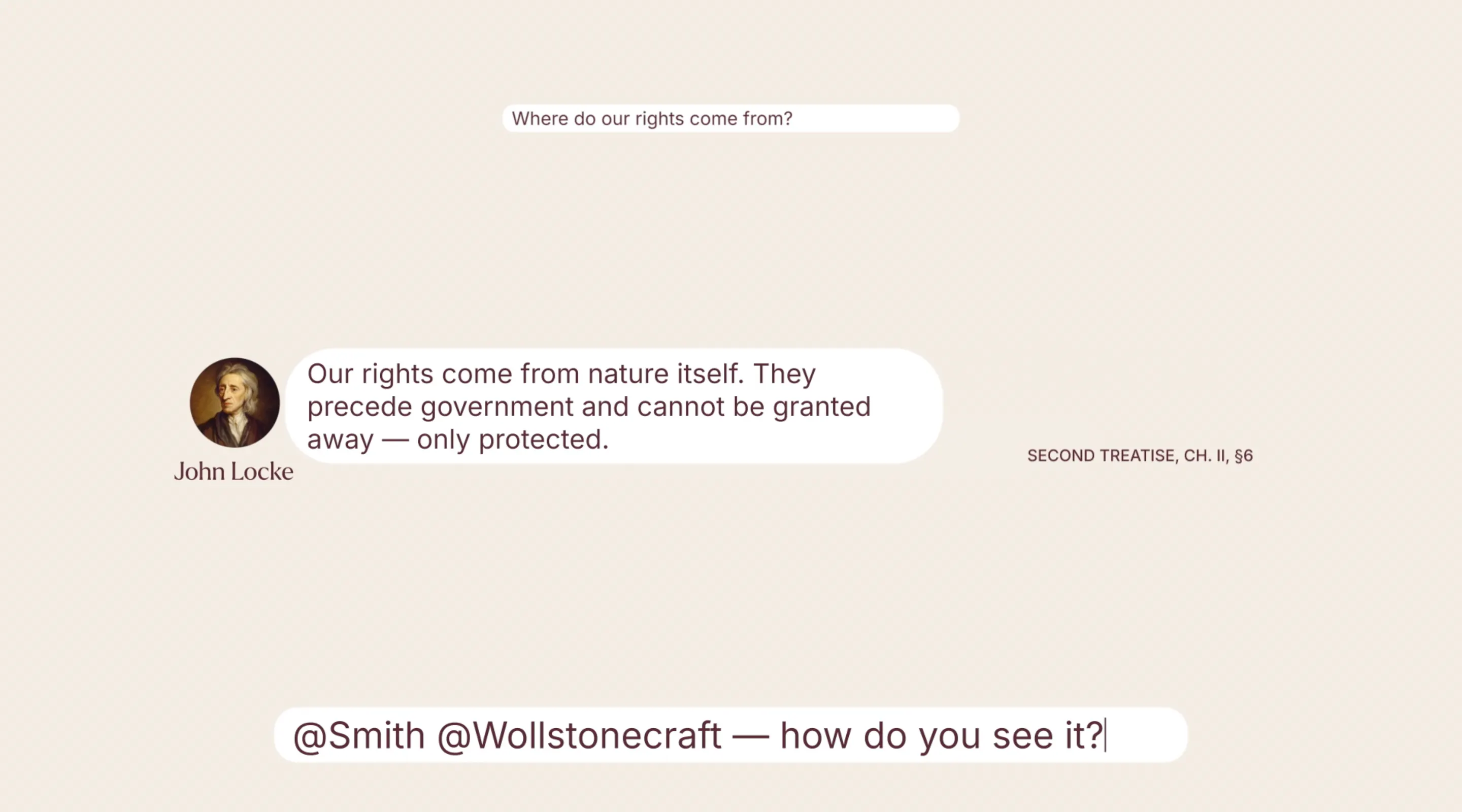
Here’s how it works: A reader asks a question about liberty, markets, justice, the design of institutions, or the nature of rights, and the platform routes the conversation to the thinker whose work is most relevant. The thinker responds in a voice grounded in their published writings, with chapter-level citations back to the primary text.
Ask Adam Smith whether the wealthy deserve their fortunes, and the answer comes from two Smiths: the defender of markets in The Wealth of Nations and the moral philosopher of The Theory of Moral Sentiments. In his own words, "the rich and the great are the objects of universal attention," and he warns of the "corruption of our moral sentiments" when that admiration detaches from virtue or honest industry. The reader comes away with a more complicated Smith than the caricature, and a citation to verify for themselves.
The platform also handles its limits with care. When asked about modern questions the thinkers could not have known, it does not pretend otherwise. Frederick Douglass, asked about AI's effect on labor markets, acknowledges that the technology lies beyond his historical experience, then reasons forward from themes central to his work: the dignity of labor, the moral structure of economic life, and equal citizenship in the Republic.
Each response ends with a Socratic follow-up question designed to deepen the conversation or test the reader's assumptions. Ask Mill about whether free speech protects bad ideas, and he gives the canonical defense before asking: “what about ideas ‘so demonstrably false or repugnant’ that ‘the potential for enlightenment appears negligible and the risk of tangible harm becomes profound’”? The experience is designed to feel less like a search engine and more like office hours with the central thinkers of the liberal tradition.
The list of 29 is itself an editorial argument. The tradition that built the modern free society—organized around free inquiry, individual rights, constitutional limits on power, and the rule of law—is neither narrow nor finished. It contains voices that disagreed sharply with one another, and continues to evolve through those disagreements. Classical Liberal Mind makes those arguments available again, with each thinker presented on their own terms, for a generation that needs to engage seriously with the arguments rather than inherit simplified labels.
Try it at ClassicalLiberalMind.ai and watch the video below.