
David Schmidtz spent five years delivering mail in Calgary, Alberta, before a professor told him he had a spark. Forty years later, he is a chaired professor who helped build the field of philosophy, politics, and economics. It almost didn't happen.
In 1982, David Schmidtz was a mailman with a problem. He had been delivering mail in Calgary for five years, chipping away at a science degree in night courses, and his oldest credits were about to expire. Finish or quit. The only senior humanities elective he could still take that summer, in the evenings, was a graduate seminar on Hume's Treatise. He was, by his own account, completely lost in it.
"Half a dozen flukes like that are the reason why I'm not a mailman anymore."

Partway through, the professor, Robert Carr-Wiggin, took him aside. You're a mailman picking up an extra credit, Carr-Wiggin told him, while your classmates are people building careers in professional philosophy. Even so, you have something they'll never have. You've got a spark.
"Half a dozen flukes like that are the reason why I'm not a mailman anymore," Schmidtz stated.
The flukes kept coming. When one of his brothers died, Schmidtz took a leave from the post office and moved to Saskatoon to grieve with family. His days were empty, so he asked the University of Saskatchewan's philosophy chair whether he might sit in on a few courses.
The chair refused. Philosophy, he said, is not something you do to kill time. But after the two talked for half an hour about what philosophy is, the chair told him which classes to take and handled the registration himself. That is how a mailman came to hold a second undergraduate degree, this one in philosophy.
Graduate school at the University of Arizona nearly ended the story. On the first day of his first class in political philosophy, the professor asked how scarce health care resources should be distributed. The room went silent. Schmidtz raised his hand and offered what seemed to him the obvious opening move: health care costs money, so start with the people willing to pay what it costs, then argue from there. The professor laughed and said, "That's like something a libertarian would say." The class laughed too. Schmidtz had never heard the word. What he said to himself was: "You'll hear me say this again. And the next time I say it, you won't laugh."
The premise had been with him long before graduate school. He grew up on a Saskatchewan farm and saw what it took to grow food; he knew it did not come from the supermarket, and that nothing worth having comes free. A mug from his mailman days had given that knowledge an image and a phrase. It was his favorite: a small fish about to be swallowed by a bigger fish about to be swallowed by a bigger one still, over the caption, "there's no such thing as a free lunch."
That is why the opening answer seemed obvious to him, and why he could say it: he had come to philosophy from outside, and had never picked up the habit of performing for the room. It was also, most likely, what Carr-Wiggin had seen in the Hume seminar. While the other students worked out what would impress the professor, Schmidtz was working out what was true. Even so, by the end of his first year at Arizona his funding was cancelled. He was underprepared and out of his depth, and his professors saw nothing to invest in. He says he can't blame them. But he caught on with the Economics Department, and by the time he finished his MA in economics, philosophy wanted him back.
"The brilliant thing that IHS did was making connections. Horizontal connections with classmates, and vertical connections with people who could really help in a person's career."
Along the way, a classmate stopped him one day. Have you ever heard of the IHS? Go upstairs and look at the poster. It sounds like they're talking about you.
Schmidtz applied for a fellowship and didn't get it. But that fall, IHS's Walter Grinder called with unexpected news. A windfall had arrived, and Grinder wanted to divide it among three students he had thought were worthy all along. Two thousand dollars, and an invitation to his first Liberty & Society summer seminar in 1984. The student whose funding had been canceled went on to become an assistant and then associate professor at Yale, and then spent almost three decades back at Arizona, where he became Kendrick Professor of Philosophy and founded the Center for the Philosophy of Freedom.
Since 2012 he has edited Social Philosophy and Policy, a Cambridge University Press journal that has put philosophers, economists, and legal scholars into the same conversation for four decades, and helped build the field now known as PPE. Today he holds the Presidential Chair of Moral Science at West Virginia University.
"The brilliant thing that IHS did was making connections," Schmidtz said. "Horizontal connections with classmates, and vertical connections with people who could really help in a person's career."
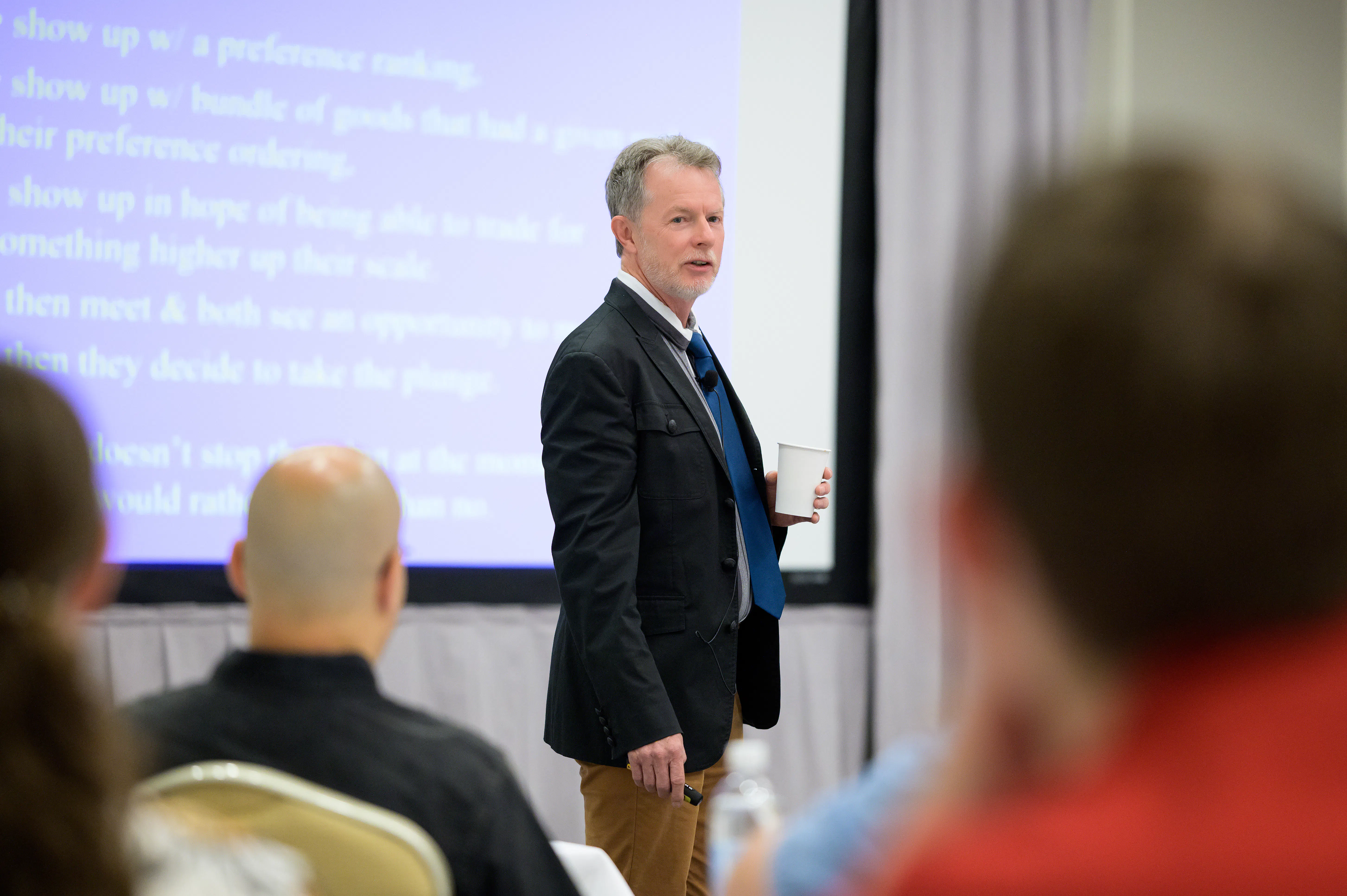
Ask him what IHS actually did for him, though, and the money is not the first thing he mentions. He talks about the classmates he still knows four decades on, and the journal editors a struggling student could never have met on his own. Then he turns the story around. For four decades he stood at the front of IHS seminar rooms, and the students from those rooms keep finding him at conferences. I was in the room when you gave that lecture, they tell him. That's when I decided to go to graduate school, some would say.
The lecture varies. For some it was his argument that a property rights system takes the tragedy of the commons, a game everyone loses, and turns it into a game everyone can win. For political scientist Lauren Hall, it was a session on African wildlife management, which she still points to as the moment abstract theory became concrete for her. One of those students is now his dean.
There are, he estimates, a hundred stories like that: people who saw a light at an IHS seminar and followed it into the academy. But when he says this, he is quick to add that the number is not the point. "It doesn't matter that there's hundreds," Schmidtz says. "What matters is that there's one."
He is still teaching, now to business students rather than philosophy majors. "My students don't need me to prepare them to major in philosophy," he says. "They need me to prepare them to live a life."
A professor once pulled a lost mailman aside to tell him he had a spark. Schmidtz has been fanning that spark in his students ever since.